
Energy systems for businesses, property owners and industry
Businesses that build their own resilience.
Solar PV, battery storage and control, delivered as one system rather than separate components. The return is counted in years, not decades.
Grid capacity in Sweden
About 55,000 MW
is queuing for a connection to Sweden's transmission grid (Svenska kraftnät, early 2026). Businesses that need power are waiting.
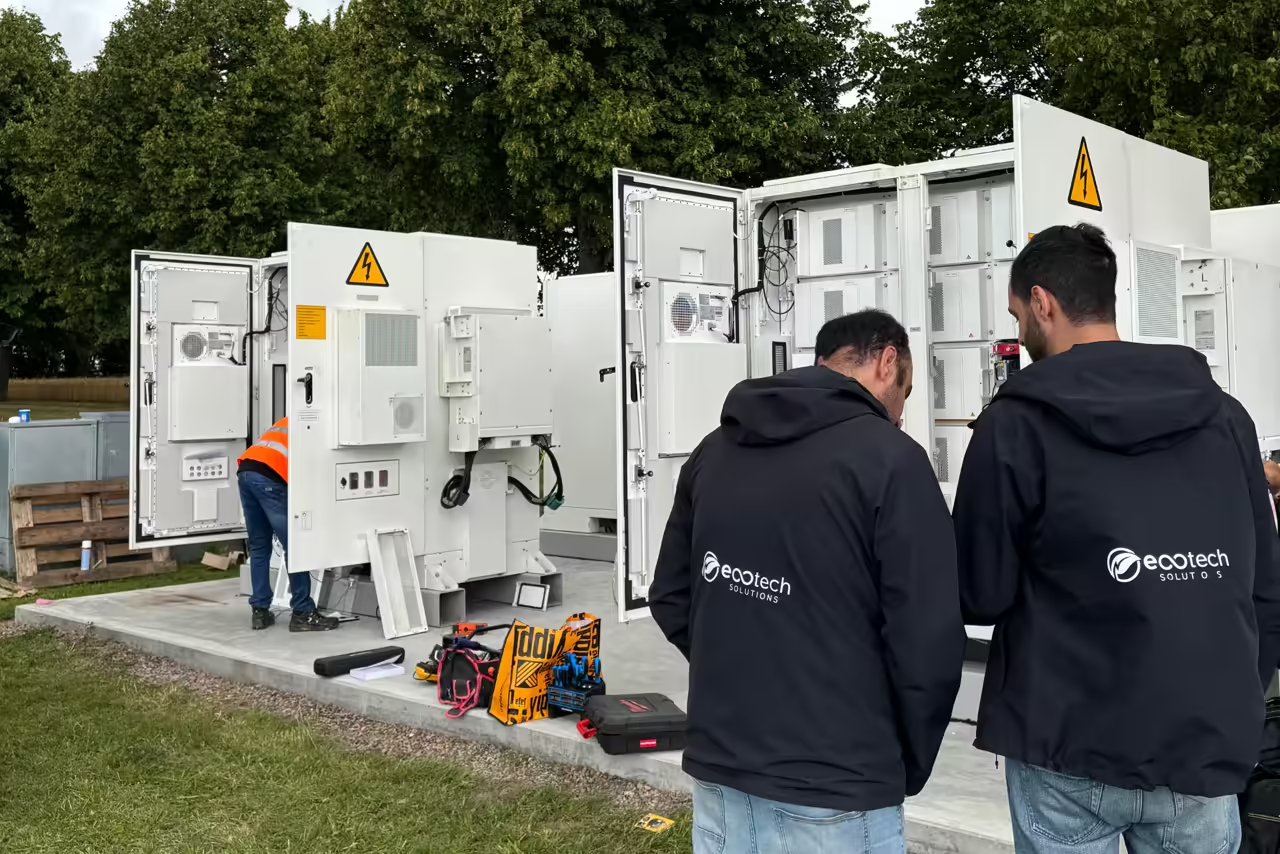
The EcoHub system
Three parts.
One system.
Each part does one job. Together they decide what the property pays per kilowatt hour, and what happens when the grid fails.
01 — Solar PV
Power from your own roof.
Electricity is produced where it is used. No transmission, and no grid fee on that kilowatt hour.
02 — Battery storage
Cuts the peaks.
A battery cuts the property's highest demand peaks, the hours that set the whole grid tariff, and makes the property more resilient.
03 — EcoHub control
Results from day one.
EcoHub controls solar PV, the battery and EV charging in real time, optimising against spot prices, weather forecasts and consumption patterns. Around the clock.
Flagship case study
Same property.
Half the electricity price.

With 59 kWp of solar PV, a 97 kWh battery and EcoHub, the property paid SEK 1.15 per kWh instead of SEK 1.80 from January to October 2026. Including revenue from frequency reserves, the effective electricity price was SEK 0.87.
- −52%
- Effective electricity price Jan–Oct 2026, SEK 1.80 → 0.87 per kWh, incl. frequency reserves
- −36%
- Electricity bill Jan–Oct 2026
- 71 of 71
- Hours above the main fuse limit covered by solar and battery
- Every month
- Lower electricity price than without the system, even in January
Why EcoTech
We don't sell solar panels.
We build resilience.
The value is in the control. The same hardware, controlled against price and power, gives a better operating result and a site that stays up when the grid goes down.
Software on top of hardware
Same site, more value
EcoHub increased the monthly value of an existing installation in southern Sweden by 122–160 %. No new panels, no new battery.
Revenue, not just savings
An idle battery can still earn money
Capacity not needed for peak shaving can be bid into the frequency reserve markets. A cost line becomes a revenue line.
Full responsibility
Survey, design, installation, operation
One counterpart through the whole chain. The customer doesn't coordinate installers, apply for permits or make technical decisions alone.
Commissioning
16–24 weeks from first contact
Industrial projects are fully operational in 16–24 weeks, and simpler installations from 120 days. The grid connection takes longer than the installation.
Financing
Invest smart, or avoid the investment
Financing arrangements that keep capital commitment low. The effect shows in operating income from the first month, not after depreciation.
Open standards
No lock-in to hardware or an electricity supplier
EcoHub works with established hardware brands and is not tied to any electricity supplier. Charging follows OCPP 2.0.1, ISO 15118 and OCPI.
Operational reliability
Takeover in milliseconds
With island mode, an optional add-on, critical loads are prioritised during an outage, with integration to UPS, SCADA and BMS where available. 99.9 % operational reliability in industrial projects.
Investment support
Support applications built on data you already have
The application uses the same measurements and sizing the system is designed from. We prepare the documentation, so you don't have to guess.
Measured
Figures from sites in operation
Every figure below comes from a site we commissioned or re-tuned the control of. The measurement period is stated in each case study.
- Effective electricity price Jan–Oct 2026, SEK 1.80 → 0.87 per kWh, incl. frequency reserves
- −52 %
- Electricity bill Jan–Oct 2026
- −36 %
- Hours above the main fuse limit covered by solar and battery
- 71 of 71
- Lower electricity price than without the system, even in January
- Every month
- Payback period in industrial projects
- Under 6 years
- From data to ROI forecast
- 48 h
Next step